- The CS Digest
- Posts
- I stalk my execs (and you should too)
I stalk my execs (and you should too)
My 6-step prep before any executive call

Erika Villarreal
March 31, 2026
Hi there,
There are no shortcuts to executive conversations.
If you want to be seen as a strategic partner, you have to do the work.
One of the best books I’ve read on this is Selling to the C-Suite. There’s a quote that stuck with me:
“Executives expect you to be prepared and have a basic knowledge of the key issues facing them—before you meet them.”
Let that sink in.
Before you meet them.
Not during the call.
Not after discovery.
Before.
Because from their perspective, everything you need is already out there:
Their company’s strategy
Their industry challenges
Their priorities
Their pressure
They don’t have time to walk you through it.
And if you show up asking questions you could have answered yourself… you lose credibility before the conversation even starts.
Another line from the book says it even more directly:
“It may require a substantial amount of digging.”
That’s the job.
The difference between a reactive CSM and a strategic one is simple:
One shows up with questions (“What’s keeping you up at night?”- Sound familiar?)
The other shows up with context.
So let’s talk about how to do that digging.
Let’s assume the executive stakeholder is a VP, Global Real Estate.
1. Start with LinkedIn (but go deeper than most)
Most CSMs glance at a profile. Strategic CSMs study it.
Look for:
Time in their role
Previous experience
Recent promotions
Posts or articles shared
Language they use repeatedly
If your executive keeps talking about “cost optimization” or “efficiency,” that’s your signal.
That’s the language you should be using in your next conversation.
2. Use AI to understand their role in minutes
You don’t need to guess what your executive cares about.
Use AI to study their role.
Prompt example:
“What KPIs is a VP of Global Real Estate typically measured on in a Fortune 500 financial services company?”
In 30 seconds, you’ll get:
Cost per seat
Total occupancy cost
Portfolio optimization
Space utilization
And their number 1 priority?
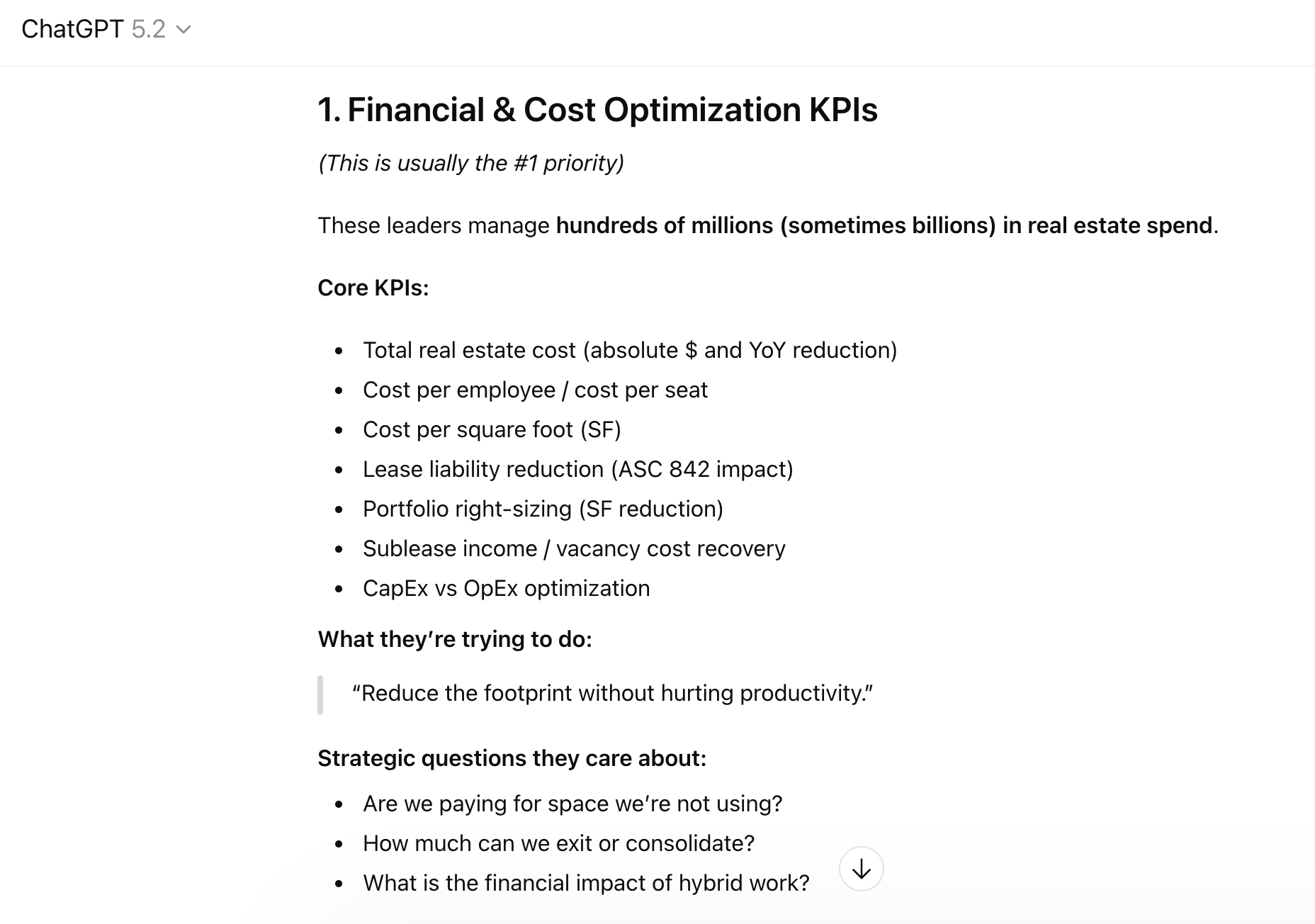
Now you understand how they are measured.
If you don’t know the scoreboard, you can’t connect your product to value.
(And remember: validate what AI gives you. It’s a starting point, not the answer.)
3. Search for conferences, interviews, and panels
Google their name plus:
Conference
Keynote
Interview
Podcast
Executives often say publicly what they won’t repeat in a 30-minute call.
While researching one of my executive stakeholders (VP, Global Real Estate), I found a conference where he was speaking.
The topic?
“Business-driven technology strategy for a shifting corporate Real Estate and Facilities market.”
That told me everything.
How he was thinking about automation, technology strategy, and innovation across a global portfolio.
So I prepared differently.
Instead of asking, “How is everything going?” I said:
“I saw your session on business-driven technology strategy. You mentioned automation and better portfolio visibility. Are you confident in the data guiding your consolidation decisions today?”
The tone shifted immediately, and this opened up a discussion on one of the most pressing challenges he was facing: measuring actual utilization, not just booking utilization. This eventually led to a solution that allowed us to measure badge swipes to improve occupancy accuracy - a key metric that helps guide decisions for portfolio optimization.
When you listen to how executives speak externally, you gain their language, their focus, and their level of ambition.
That’s how you prepare at an executive level.
4. Read similar job descriptions
Google search or go to any job site (Ej. Linkedin, Indeed, Glassdoor, ZipRecruiter).
Search for roles with the same title.
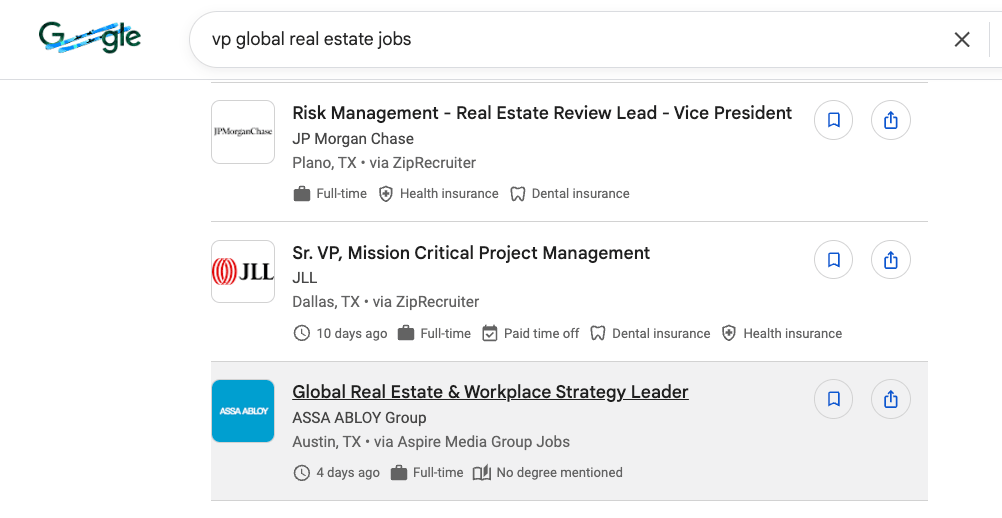
Why this matters?
Job descriptions list responsibilities, metrics, and current initiatives.

If multiple roles mention:
“Drive portfolio optimization and site planning to improve efficiency, reduce costs, and support growth.”
This tells you analytics and visibility are strategic priorities.
If your product produces utilization dashboards and reporting, now you have a direct bridge to business outcomes.
5. Review public financial reports (if applicable)
If your customer is public, read their 10-K report.
You don’t need to read every page. Use AI to summarize the most relevant sections tied to how your product can help that executive.
For my industry (workplace), I look at:
Cost reduction initiatives
Real estate footprint
Operating leases and costs
Operational efficiency
Risk factors
Strategic initiatives
Hybrid work initiatives
When I did this for a financial services customer, I uncovered:
7% reduction in square footage year over year
$81M decrease in lease liabilities
Clear hybrid work positioning
Imagine walking into a meeting and saying:
“I noticed lease liabilities decreased by $81M since 2022. What data is driving your decisions around which leases to renegotiate or exit next?”
That signals preparation and business acumen.
6. Tie everything back to your product
Research alone doesn’t make you strategic.
Translation does.
Instead of saying:
“Adoption is low.”
You say:
“If we increase adoption from 20% to 70%, we can improve visibility into space utilization and support your cost reduction goals.”
That’s the shift:
Feature → Behavior → Data → Business impact.
How to prepare like a pro
Before every executive meeting, ask yourself:
Do I know how this person is measured?
Do I understand their top 2–3 strategic priorities?
Can I clearly connect my product to those priorities?
Am I bringing one relevant insight to the conversation?
If the answer is no, pause and prepare.
Executives don’t need more status updates.
They need clarity, context, and direction.
Research is not extra work. It is part of the job.
And if you want the full ICE research framework (Industry, Company, and Executive Stakeholder) plus AI prompts and templates, it’s all part of the Success Plan Playbook (Coming soon!)
If building stronger executive relationships is one of your goals this year, this is your starting point.
Best,
Erika

Erika Villarreal
Reply